
Featured Jets
Choosing the Right Jet: How Aircraft Matching Actually Works
There is no best private jet. There is only the right aircraft for a specific trip, and the same trip flown a week later with two more passengers may need a different one.
Most guides to types of private jets are catalogues. They list the classes, print the specifications, and leave you to work out which one applies to you.
This is the other version: how the decision is actually made, and which four variables decide it.
The Aircraft Classes, and What Each One Is For
Five classes, plotted by typical range
Turboprops
Most charter guides skip turboprops or treat them as a lesser option. That is a mistake. On a 400-mile leg into a short field, a King Air 350 will beat a light jet on cost and match it on arrival time, because the jet's speed advantage never gets a chance to compound. Turboprops also handle unpaved and short runways that jets cannot use at all, which matters for ranch, hunting and energy-sector destinations across West Texas and the Mountain West.
Right for: short regional legs, small groups, remote or short-runway airports, cost-sensitive trips.
Very light and light jets
Typical aircraft include the Embraer Phenom 100 and 300, the HondaJet HA-420 and the Cessna Citation CJ series. Cabins are comfortable but not tall. Most very light jets have no room for a cabin attendant, and baggage capacity in the smallest of them can be as low as 16 cubic feet, roughly two suitcases and nothing else.
Right for: two- to three-hour trips, small groups, light baggage.
Midsize jets
The Gulfstream G150, Cessna Citation Latitude and Learjet 60 sit here. This is where transcontinental capability begins and where most business travel lands. Baggage capacity jumps substantially: a Citation Latitude carries around 127 cubic feet against 74 in a light jet, which is often the deciding factor rather than seats.
Right for: cross-country trips, full working groups, real luggage.
Super-midsize jets
The Bombardier Challenger 350, Gulfstream G200 and Citation Sovereign are the familiar names. Coast to coast nonstop against a headwind, comfortably, with a full cabin. The step up from midsize is mostly about range reliability and cabin volume rather than speed.
Right for: transcontinental nonstop, larger groups, longer days.
Heavy and ultra-long-range jets
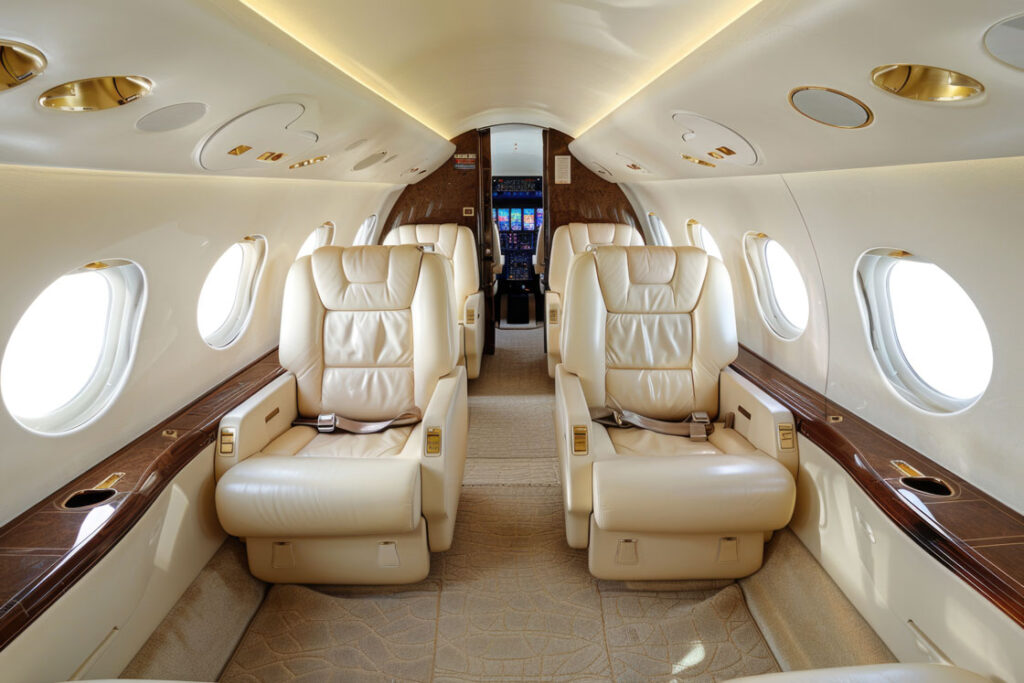
Full galleys, enclosed lavatories, dedicated sleeping areas, two cabin attendants on the larger types. Bombardier Challenger 605, Gulfstream G550 and G650, Dassault Falcon 900 and 7X, Bombardier Global 6000.
Right for: international and transoceanic travel, large groups, flights where rest on board is part of the plan.
Published range is a maximum under favorable conditions. It shrinks with passengers, baggage and headwind.
The Four Variables That Decide the Aircraft
Everything above is context. These four are the actual inputs.
Passenger count
Not the maximum seat count, the working seat count. A jet certified for nine passengers seats nine people who are not using tables, not spreading out, and not carrying much. If the group intends to work across a conference layout, the practical capacity is lower than the brochure figure, and larger parties move into group charter territory sooner than expected.
Distance, with reserves
Published range is measured under favorable conditions with a standard payload. Add passengers, add bags, add a headwind, and it shrinks. A trip that sits just inside an aircraft's book range on paper may need a fuel stop in practice. This is the single most common source of unpleasant surprises, and it is why range gets checked against the actual load and the actual forecast rather than the specification sheet.
Runway length at both ends
A hard constraint, not a preference. Some of the most useful airports in the country have runways too short for midsize and larger jets, and a few are unpaved. If the destination field limits you, the aircraft decision is made before any other variable is considered.
Baggage volume
The most consistently underestimated input in charter. Golf clubs, ski bags, hunting cases and camera equipment consume space that seat counts do not describe. Tell your advisor what is going in the hold at quote stage, not at the FBO.
Baggage capacity, by class
Four passengers with four sets of skis and boots do not fit in an aircraft that comfortably seats six.
Why the Cheapest Aircraft Is Often the Wrong One
Fort Worth to Aspen, four passengers, ski gear, in February. The light jet quotes lower per hour. But with four passengers, full bags and winter conditions at a high-altitude airport surrounded by terrain, it may need a fuel stop en route, and its performance limits at Aspen are tighter. Add 45 minutes on the ground plus the climb and descent either side, and the cheaper aircraft arrives more than an hour later.
The midsize quotes higher per hour and flies it nonstop. Total cost is closer than the hourly rates suggest, and the trip is materially better.
Hourly rate is one line in the quote. The right comparison is total trip cost against total trip time.
Three Trips, Three Aircraft
The same question, three different answers
Not for the seats, for the baggage volume and the nonstop range with a full load into a demanding airport.
Nine passengers with overnight bags exceeds practical midsize capacity once everyone is aboard, and peak-weekend availability favors committing early to the class that definitely works.
Two passengers do not need cabin volume, but the return leg westbound into a headwind is where range gets tested. If the day is tight, the midsize protects the schedule.
Aircraft availability varies by date and is confirmed per trip.
What We Ask Before Recommending an Aircraft
The questions are always the same, and none of them are about which jet you like.
- How many people, and will they need to work?
- Where exactly, and what are the runway limits at both ends?
- What is going in the hold?
- Is this a there-and-back day, or are you staying?
- What is the one thing that cannot slip?
The answers determine the class. The class determines what we source. Precision, consistency, no luck.
Frequently Asked Questions
What are the different types of private jets?
The main categories are turboprops, very light jets, light jets, midsize jets, super-midsize jets, heavy jets and ultra-long-range jets. They are separated by passenger capacity, range, cabin size and runway requirements, running from roughly six passengers and 1,000 nautical miles at the small end to nineteen passengers and 7,500 nautical miles at the large end.
What size private jet do I need for my group?
Passenger count is only the starting point. Four passengers with ski or golf equipment often need a larger aircraft than eight passengers with carry-on bags, because baggage volume and range with a full load usually bind before seats do. Runway length at your destination can override both.
What is the difference between a light jet and a midsize jet?
A light jet typically carries five to eight passengers up to about 2,000 nautical miles, with limited baggage space and a cabin you cannot stand up in. A midsize jet carries seven to nine passengers up to about 3,000 nautical miles, usually with standing headroom, an enclosed lavatory and roughly twice the baggage capacity.
Which private jet is best for a family?
For most family trips a midsize jet is the practical choice. It offers standing headroom, an enclosed lavatory and enough baggage volume for luggage plus sports or ski equipment, while still accessing smaller airports closer to the destination. Shorter regional trips are often better served by a turboprop.
Tell Us the Trip, Not the Aircraft
Describe where you need to be, who is coming and what you are bringing. We will match the aircraft to the mission.
Trilogy Aviation Group is an on-demand charter broker based in Fort Worth, Texas. We are an ARGUS-registered and Wyvern-certified broker with access to more than 7,000 aircraft, and we arrange flights with FAA Part 135-certificated operators worldwide.