
TAG Talk
Not All Private Jet Wi-Fi Is Created Equal
Two aircraft, same class, same route, same price. One lets you run a Teams call from 41,000 feet without anyone noticing where you are. The other struggles to load email. The difference is the connectivity system installed on that specific tail number.

Two aircraft, same class, same route, same price. One lets you run a Teams call from 41,000 feet without anyone noticing where you are. The other struggles to load email. The difference is not the aircraft. It is the connectivity system installed on that specific tail number, and it is the single most overlooked question in private jet charter.
If you intend to work in the air, this is what you need to understand before you book.
Why In-Flight Wi-Fi Disappoints People
The assumption is reasonable: private aircraft, private price, therefore fast internet. It has never been reliably true. Most in-flight connectivity until recently ran on geostationary satellites parked 22,000 miles above the equator, or on ground-based cell towers. Both work. Neither was built for what people now expect from a connection. The result is a cabin where email eventually arrives and video calls do not happen. That is changing quickly, but unevenly. Which is exactly why the aircraft matters more than the category.
The Three Types of Private Jet Connectivity
Three systems, plotted by typical download speed
Air-to-ground (ATG)
A network of ground towers pointing upward. The aircraft connects to towers as it passes overhead, in the same way a phone hands off between cell sites. Latency is low because the signal only travels a few miles. Bandwidth is not. Legacy ATG networks typically deliver 3 to 10 Mbps shared across the whole cabin. Coverage stops at the coastline, so ATG is continental US only and useless over water. Newer 5G ATG networks improve this substantially, up to roughly 75 Mbps per aircraft, but the coverage limit does not change.
Good for: domestic flights, email, messaging.
Geostationary satellite (Ka-band and Ku-band)
Satellites in fixed orbit roughly 22,000 miles up. Because they cover enormous areas, coverage is genuinely global, including oceans. The physics is the catch. At that altitude, the round trip for a signal imposes a floor of about 480 milliseconds before anything else is accounted for, and real-world latency runs 600 milliseconds or higher. Speeds vary widely by system, typically 15 to 70 Mbps per aircraft. Newer Ka-band systems perform better than the older hardware still flying on a lot of aircraft.
Good for: international and transoceanic flights, browsing, streaming. Poor for live calls.
Low Earth orbit (LEO)
Satellites at 340 to 570 kilometers instead of 35,800 — roughly one sixtieth the distance. That single change collapses latency to under 100 milliseconds, and often under 40. Starlink Aviation is the system most charter passengers have heard of. Real-world business jet performance lands around 135 to 310 Mbps download with latency below 99 ms. Gogo Galileo, running on the Eutelsat OneWeb constellation, is the other LEO option; its smaller HDX antenna is sized for light and midsize aircraft and delivers up to 60 Mbps, while the larger FDX antenna reaches roughly 195 Mbps.
Good for: everything. This is the closest in-flight equivalent to home broadband.
Speeds are typical per-aircraft figures. Actual performance varies by system generation, satellite coverage and how many passengers are connected at once.
| System type | Typical speed per aircraft | Typical latency | Ocean coverage |
|---|---|---|---|
| Legacy air-to-ground | 3-10 Mbps | Low | No |
| 5G air-to-ground | Up to 75 Mbps | Low | No |
| Geostationary satellite | 15-70 Mbps | 600 ms+ | Yes |
| LEO (Starlink, Gogo Galileo) | 60-310 Mbps | Under 100 ms | Yes |
What Starlink Actually Changes
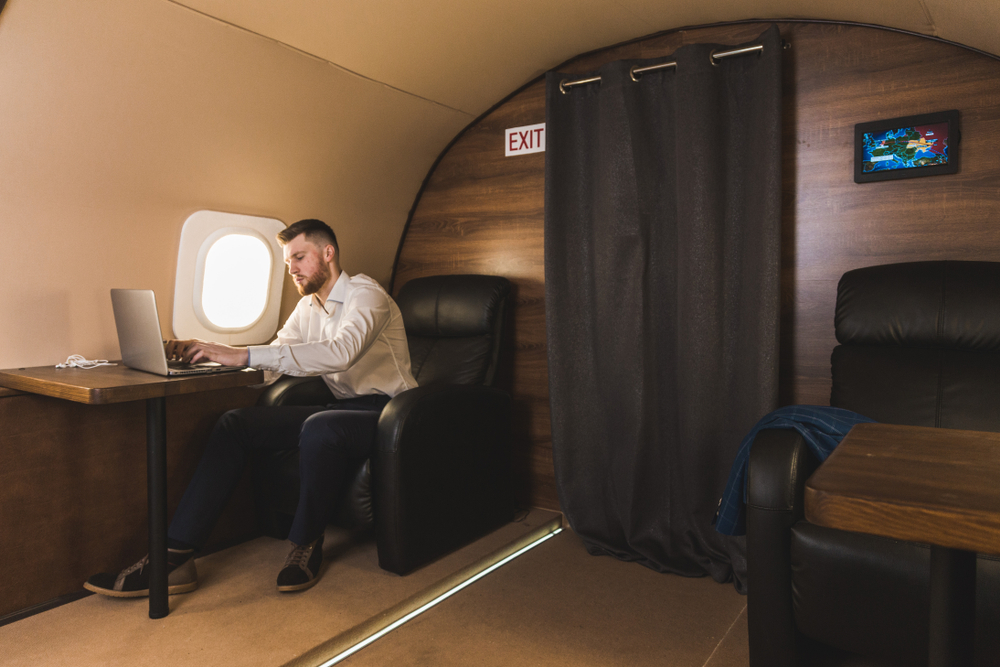
The headline is speed. The real story is latency. Six hundred milliseconds of delay is what makes a satellite video call unbearable — the pause where everyone talks over each other. Under 100 milliseconds, that pause disappears and the call feels ordinary. Below 40, it feels local. The practical consequence is that a three-hour flight stops being three hours of downtime. VPN sessions hold. Live calls work. Multiple passengers can be on separate calls at once, which older systems could not support at any speed.
Six hundred milliseconds of delay is what makes a satellite video call unbearable. Under 100 milliseconds, that pause disappears and the call feels ordinary.
The Part Nobody Advertises
Starlink is not on every aircraft. Adoption in business aviation has been fastest at the top of the market — large-cabin and long-range jets, where the installation cost is easier to justify against the aircraft's value. Light and midsize retrofits are catching up but are not there yet, and turboprops are further behind again.
This produces the situation worth planning around: on a light or midsize charter in 2026, the connectivity on board is genuinely variable. It might be excellent. It might be legacy ATG. The category tells you nothing. Only the tail number does.
What This Means for Your Trip
If you are flying to a destination and the flight is dead time either way, this does not matter much. If the flight is working time, it is one of the most consequential specifications on the aircraft — more consequential, for most business travelers, than cabin dimensions or catering. A three-hour flight with a connection that works is three hours you do not have to make up in the evening.
This is why we confirm the connectivity system on the specific aircraft before a trip is booked rather than after. If a working connection is a requirement, it becomes a filter on which aircraft we source, in the same way runway length or baggage volume does. Precision, consistency, no luck.
Questions to Ask Before You Book
Ask these about the actual aircraft, not the operator or the category:
- What connectivity system is installed on this tail number?
- Is it air-to-ground, geostationary satellite, or LEO?
- Does coverage extend over water on this routing?
- How many passengers can stream or take calls at the same time?
- Is there a usage cap or an additional charge?
- Is the system currently serviceable?
Any charter advisor should be able to answer all six before you sign. If the answer is a general statement about the fleet rather than a specific one about your aircraft, ask again.
Frequently Asked Questions
Do all private jets have Wi-Fi?
No. Most modern business jets have some form of connectivity, but coverage, speed, and usability vary enormously, and older aircraft and turboprops may have none at all. Connectivity is a per-aircraft specification rather than a category standard, so it should be confirmed on the specific tail number before you book.
Does Starlink work on private jets?
Yes. Starlink Aviation is certified on a growing number of business aircraft and delivers roughly 135 to 310 Mbps with latency under 100 milliseconds in real-world use. Adoption has been fastest on large-cabin and long-range jets; light and midsize retrofits are still catching up, so availability depends on the individual aircraft.
Can you take a video call on a private jet?
On a LEO system such as Starlink or Gogo Galileo, yes — latency is low enough that calls feel normal. On older geostationary satellite systems, latency above 600 milliseconds makes live calls frustrating and often unusable. On legacy air-to-ground, bandwidth is generally too limited for video.
Is private jet Wi-Fi free?
It depends on the operator and the system. Some include connectivity in the charter rate; others bill by data used or by the hour, and high-bandwidth LEO service is more likely to carry a charge. Ask for the cost structure at quote stage so it appears in the price you compare, not on the invoice afterward.
Ask Us About the Aircraft, Not the Category
Trilogy Aviation Group is an on-demand charter broker based in Fort Worth, Texas. We are an ARGUS Registered and Wyvern certified broker with access to more than 7,000 aircraft, and we arrange flights on FAA Part 135 certificated operators worldwide. If connectivity matters on your trip, tell us at the quote stage, and we will source against it.